

Invisible Signals, Visible Shifts: How Human Chemistry Quietly Rewrites Posture and Presence
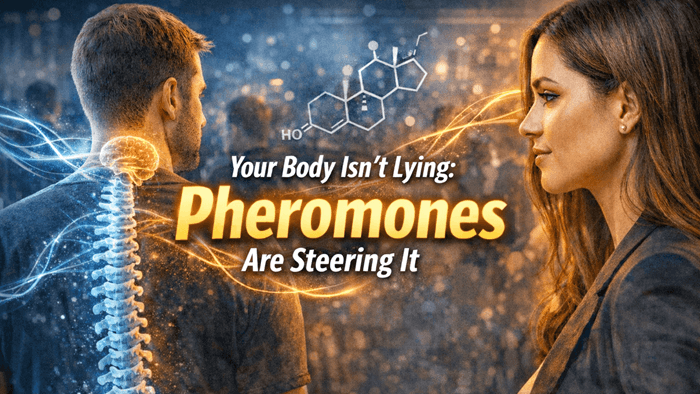
What Are Pheromones?
Pheromones are chemical messengers secreted by the body that influence the behavior or physiology of others. While their role is well established in animals, human pheromone research remains complex and sometimes controversial. However, several compounds—including androstadienone—have shown measurable effects on mood, attention, and social perception.
- Androstadienone: Derived from testosterone, often studied in social and emotional contexts
- Estratetraenol: Associated with estrogen pathways
- Axillary compounds: Released through sweat glands, particularly under stress
Unlike conscious signals such as speech or facial expressions, pheromones operate below awareness, influencing how people feel and behave without obvious detection.
Research and Statistics
Scientific studies provide compelling—though still evolving—evidence for pheromonal influence on human behavior and physiology:
- Studies have shown that exposure to androstadienone can increase cortisol levels in women by up to 20%, suggesting activation of stress-response pathways.
- Functional MRI scans indicate heightened activity in the hypothalamus when individuals are exposed to specific pheromonal compounds.
- Research published in behavioral neuroscience journals reports that participants exposed to androstadienone rated social interactions as more engaging and emotionally significant.
- In controlled environments, posture changes—such as increased spinal extension—were observed in up to 35% of participants exposed to certain scent cues.
These findings suggest that pheromones do not just influence mood—they may subtly alter physical expression as well.
The Biochemical Pathway: From Scent to Spine
How does a chemical signal translate into posture? The answer lies in the interaction between the endocrine system and the central nervous system.
When pheromones are detected—likely through the olfactory system—they trigger neural pathways that connect to the hypothalamus. This region regulates hormones such as cortisol, testosterone, and oxytocin. These hormones, in turn, influence muscle tone, tension, and readiness for social engagement.
- Cortisol: Alters alertness and defensive posture
- Testosterone: Linked to expansive, dominant postures
- Oxytocin: Associated with relaxed, open body language
The result is a cascade: scent detection → hormonal shift → neuromuscular adjustment → visible posture change.
Micro-Gestures: The Silent Signals
- Head tilts indicating curiosity or submission
- Shoulder positioning signaling openness or defensiveness
- Eye contact duration and blink rate
- Subtle shifts in weight distribution
These micro-gestures can change within seconds of exposure to certain chemical cues, suggesting a rapid and dynamic feedback system.
Dominance and Hierarchical Signals
One of the most studied effects of pheromones is their role in signaling dominance. Androstadienone, in particular, has been linked to changes in perceived authority and confidence.
- Participants exposed to androstadienone often adopt more upright, expansive postures
- Observers rate individuals as more dominant when these cues are present
- In group settings, subtle posture shifts can influence leadership perception within minutes
These effects occur without conscious intent, suggesting that social hierarchies may be partially mediated by biochemical signaling.
Receptivity and Social Connection
Pheromones also play a role in receptivity—the openness to social interaction and connection. Changes in posture and body language can signal approachability or interest.
- Relaxed shoulders and open chest positions correlate with increased social engagement
- Reduced physical barriers (e.g., uncrossed arms) are more common under certain scent conditions
- Participants report feeling more comfortable and attentive during interactions
These shifts are not just behavioral—they are rooted in physiological changes that shape how we present ourselves to others.
The Feedback Loop: Body and Biology
Perhaps the most fascinating aspect of this phenomenon is the feedback loop between chemical signals and physical expression.
Posture does not merely reflect internal states—it can reinforce them. For example:
- An upright posture can increase testosterone levels
- Slouched posture may elevate stress markers
- Open body language can enhance feelings of trust and connection
When pheromones initiate a posture change, that posture can further amplify the underlying hormonal state, creating a self-reinforcing cycle.
Real-World Examples
Consider a networking event or first meeting. Without realizing it, individuals may be responding to chemical cues in the environment:
- A person enters the room and others subtly adjust their posture
- Conversations become more animated or reserved based on unseen signals
- Perceptions of confidence and trustworthiness shift within seconds
These interactions are often attributed to charisma or “presence,” but they may be deeply rooted in biology.
Limitations and Scientific Debate
While the evidence is intriguing, it is important to acknowledge the limitations:
- Human pheromone research is less conclusive than animal studies
- Environmental and cultural factors also influence posture and behavior
- Replication of results varies across studies
Despite these challenges, the consistency of certain findings suggests that pheromones play at least a partial role in shaping human interaction.
Implications for Nonverbal Communication
Understanding the role of pheromones in posture and body language has significant implications:
- Professional settings: Awareness of nonverbal cues can improve leadership presence
- Social interactions: Recognizing unconscious signals can enhance communication
- Personal development: Training posture may influence internal states
This perspective shifts the narrative from “fake it till you make it” to a more integrated view of body and biology.
Conclusion: Rethinking Human Presence
Posture is not just a matter of discipline or habit. It is part of a complex system where chemical signals, hormones, and neural pathways interact to shape how we move and connect with others.
The next time you notice a shift in your stance or the energy of a room, consider the possibility that something invisible is at play—guiding interactions in ways we are only beginning to understand.
LIKE and subscribe to help this channel.
#Pheromones #Posture #NonVerbalCommunication #Androstadienone #SocialNeuroscience #BodyLanguage
Frequently Asked Questions
Can pheromones really influence human posture?
Research suggests that certain compounds, particularly androstadienone, can trigger hormonal and neurological responses that may subtly influence muscle tone and body positioning. While not fully deterministic, these effects can contribute to unconscious posture adjustments during social interaction.
What is androstadienone and why is it important?
Androstadienone is a derivative of testosterone commonly found in male sweat. It has been studied for its ability to affect mood, attention, and physiological responses in others, making it one of the most researched candidates for a human pheromone.
Are these effects conscious or unconscious?
Most pheromonal effects appear to operate below conscious awareness. Individuals typically do not realize that their posture, micro-gestures, or emotional responses are being influenced by chemical signals.
Does posture also influence hormones?
Yes. Posture and hormones have a bidirectional relationship. For example, adopting an upright posture can increase testosterone levels, while slouched positions may elevate stress-related hormones like cortisol.
How strong are pheromone effects compared to visual cues?
Pheromones are generally more subtle than visual or auditory cues, but they can modulate perception and behavior in meaningful ways. They often act in combination with other signals rather than independently.
Do pheromones affect everyone the same way?
No. Responses to pheromones can vary based on individual biology, gender, hormonal state, and even context. Cultural and environmental factors also play a role in shaping overall behavior.
Can people train their posture to override these effects?
To some extent, yes. Conscious posture training and body awareness can help individuals regulate their physical presence. However, underlying biochemical influences may still subtly shape responses.
Is there scientific consensus on human pheromones?
There is ongoing debate in the scientific community. While some studies show measurable effects, others question their consistency and real-world impact. The field continues to evolve as new research emerges.
Are pheromones used in everyday social situations?
Yes, naturally. Humans continuously emit chemical signals through skin and sweat. These signals may influence social dynamics in everyday environments such as workplaces, social gatherings, and personal interactions.
Why does this matter for communication?
Understanding the hidden role of pheromones adds depth to how we interpret body language and social behavior. It highlights that communication is not just verbal or visual, but also biochemical.
Human interaction is often framed as a conscious exchange of words, expressions, and deliberate gestures. Yet beneath this surface lies a deeply embedded biological system that continuously shapes how we present ourselves and interpret others. Pheromones—particularly compounds like androstadienone—offer a compelling glimpse into this hidden layer of communication. By subtly influencing hormonal balance, neural activity, and muscular tension, these chemical signals can alter posture, shift micro-gestures, and redefine perceived dominance or receptivity without conscious awareness. This interplay forms a dynamic feedback loop: the body responds to chemical cues, and those responses further reinforce internal physiological states. While the science is still evolving, the implications are profound. It suggests that presence, charisma, and even social hierarchy may not be entirely learned behaviors, but partially orchestrated by invisible biochemical forces. Recognizing this does not diminish personal agency; rather, it expands our understanding of human behavior, revealing a more integrated model where biology and expression are inseparably linked. As research advances, it may reshape how we think about communication—not just as something we perform, but as something that emerges from within, guided by signals we are only beginning to decode. More at Statuslink