

Geodynamo Mystery: How Earth’s Molten Iron Core Generates and Sustains Our Planetary Magnetic Shield
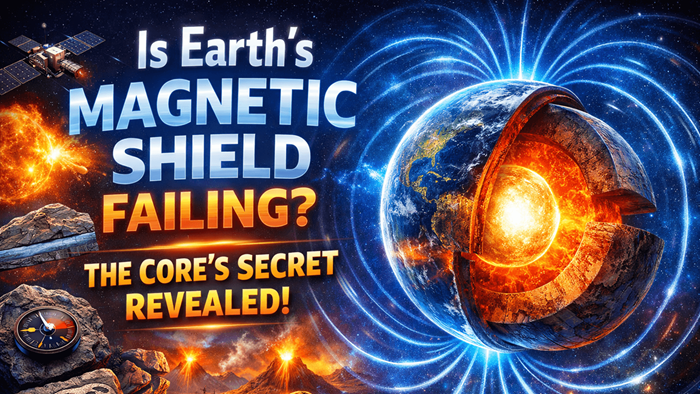
Earth’s Interior: The Architecture of a Magnetic Planet
Earth is composed of four primary layers: crust, mantle, outer core, and inner core. The magnetic story begins roughly 2,900 kilometers beneath the surface, where the solid mantle gives way to the liquid outer core.
Core Structure at a Glance
- Depth to outer core: ~2,900 km below surface
- Outer core thickness: ~2,200 km
- Composition: Primarily iron (Fe) and nickel (Ni)
- Temperature range: 4,000–6,000°C
- Inner core radius: ~1,220 km (solid iron-nickel alloy)
The outer core is entirely liquid due to extreme heat, while the inner core remains solid under immense pressure. It is the motion of electrically conductive molten iron in the outer core that creates Earth’s magnetic field.
How the Geodynamo Works
The geodynamo operates on fundamental physical principles: heat transfer, fluid motion, electrical conductivity, and planetary rotation. Together, these forces create a self-sustaining magnetic system.
The Geodynamo Process Explained
- Heat escapes from the inner core into the outer core.
- Hot liquid iron rises while cooler iron sinks, creating convection currents.
- Earth’s rotation introduces Coriolis forces that organize these flows into spirals.
- Moving conductive metal generates electrical currents.
- Electrical currents generate magnetic fields.
- The magnetic field reinforces the currents—creating a feedback loop.
This self-sustaining cycle is known as a dynamo mechanism. Earth’s version has operated for at least 3.5 billion years, based on paleomagnetic evidence preserved in ancient rocks.
Key Geodynamo Statistics
- Magnetic field strength at surface: ~25 to 65 microteslas (µT)
- Core flow speeds: Estimated 10–50 km per year
- Magnetosphere extent toward Sun: ~65,000 km
- Magnetotail length: Over 6 million km
Earth’s Magnetic Shield: Our Invisible Guardian
The magnetic field extends into space, forming the magnetosphere—a vast protective bubble that deflects solar wind particles and cosmic radiation. Without it, Earth’s atmosphere could gradually erode, much like what is believed to have happened on Mars.
What the Magnetic Field Protects Us From
- Charged particles from the solar wind
- Coronal mass ejections (CMEs)
- High-energy cosmic rays
- Atmospheric stripping
- Radiation exposure at surface level
During intense solar storms, fluctuations in the magnetic field can induce currents in power grids, pipelines, and satellites. The 1859 Carrington Event remains the strongest recorded geomagnetic storm, causing telegraph systems to fail worldwide.
Is Earth’s Magnetic Field Weakening?
Satellite missions such as ESA’s Swarm constellation have confirmed that Earth’s magnetic field has weakened by approximately 9% globally over the past 200 years. This decline is uneven, with certain regions experiencing more dramatic changes.
Notable Observations
- South Atlantic Anomaly: Region of significantly weaker magnetic intensity
- Magnetic North Pole drift: Moving ~40–50 km per year
- Global dipole decrease: ~5% per century (recent average)
The South Atlantic Anomaly affects satellites passing overhead, exposing them to higher radiation levels and causing instrument disruptions. While field weakening may sound alarming, geological records show that fluctuations are common.
Magnetic Reversals: When Poles Flip
Earth’s magnetic field has reversed polarity many times in its history. During a reversal, magnetic north becomes south and vice versa. These events are recorded in volcanic rocks and ocean floor basalts.
Magnetic Reversal Facts
- Last major reversal: Brunhes–Matuyama reversal (~780,000 years ago)
- Average interval between reversals: ~200,000–300,000 years (highly irregular)
- Duration of reversal process: 1,000–10,000 years
- Number of reversals in past 160 million years: Over 170 documented events
During reversals, the field strength can drop to 10–20% of its normal intensity. However, evidence suggests that life persisted through past reversals without mass extinctions directly linked to magnetic flipping.
Why Subtle Magnetic Shifts Matter Today
In the modern technological age, geomagnetic variations have amplified consequences. Our infrastructure depends heavily on satellites, GPS systems, aviation routes, and electrical grids.
Modern Risks from Magnetic Instability
- Satellite electronics damage from radiation exposure
- GPS and navigation inaccuracies
- Power grid transformer overloads
- Increased drag on low-Earth orbit satellites
- Radiation exposure risks for polar aviation routes
Even minor geomagnetic storms can disrupt communications. Large storms—like those that occur roughly once per century—could cause trillions of dollars in global economic damage if infrastructure is unprotected.
A Restless Core: Constant Motion, Constant Change
The outer core is not a calm ocean—it is turbulent and dynamic. Seismic wave analysis reveals complex flow patterns, including jet-like streams of molten iron. Recent research suggests the inner core may even rotate slightly faster than the mantle, a phenomenon called super-rotation.
Core Dynamics at Work
- Thermal convection driven by inner core cooling
- Compositional convection from crystallizing iron
- Coriolis effect shaping columnar flow structures
- Magnetic feedback influencing fluid motion
This dynamic interplay ensures the geodynamo remains active. If the outer core were to solidify completely, Earth’s magnetic field would likely collapse—an event that could profoundly alter planetary habitability over geological timescales.
Geomagnetism Beyond Earth
Earth is not the only planet with a magnetic field, but it is among the most stable. Comparing planetary magnetic systems helps scientists understand the conditions necessary for sustaining a geodynamo.
Planetary Magnetic Comparisons
- Jupiter: Strongest planetary magnetic field in the solar system
- Mercury: Weak but global magnetic field
- Mars: No global magnetic field (lost billions of years ago)
- Venus: Virtually no intrinsic magnetic field
Mars’ lack of a protective magnetosphere allowed solar wind to strip away much of its atmosphere. This comparison underscores the critical role Earth’s geodynamo plays in long-term climate and atmospheric stability.
Monitoring the Magnetic Future
Scientists continuously monitor geomagnetic behavior using satellites, observatories, and computer simulations. High-performance geodynamo models replicate outer core fluid dynamics to predict future trends.
Research Tools
- Satellite magnetometers
- Seismic tomography
- Ocean floor paleomagnetism studies
- Supercomputer geodynamo simulations
Although the magnetic field is currently weakening, experts caution that this does not necessarily signal an imminent reversal. The geodynamo is inherently chaotic, and fluctuations are part of its long-term behavior.
The Ongoing Geodynamo Mystery
Earth’s magnetic field is neither static nor fragile—it is dynamic, resilient, and deeply intertwined with planetary evolution. Powered by the churning iron ocean of the outer core, the geodynamo has shielded Earth for billions of years.
Yet subtle shifts—field weakening, pole drift, and potential reversals—remind us that our planet’s interior remains active and unpredictable. In a technological civilization increasingly dependent on space-based systems, understanding geomagnetism is not merely academic—it is essential.
Beneath our continents and oceans, the restless core continues its silent churn. Invisible yet indispensable, the geodynamo stands as one of Earth’s greatest natural mysteries—and one of its most vital guardians.
Frequently Asked Questions (FAQ)
What is the geodynamo?
The geodynamo is the self-sustaining process in Earth’s liquid outer core where convection currents of electrically conductive molten iron generate electrical currents. These currents produce Earth’s global magnetic field through electromagnetic induction.
What causes Earth’s magnetic field?
Earth’s magnetic field is generated by the movement of molten iron and nickel in the outer core. Heat escaping from the inner core drives convection, while Earth’s rotation organizes the flow into spirals, allowing electrical currents to form and sustain the magnetic field.
How strong is Earth’s magnetic field?
At the surface, Earth’s magnetic field ranges between approximately 25 and 65 microteslas (µT). The strength varies by location, being stronger near the poles and weaker near the equator.
Is Earth’s magnetic field currently weakening?
Yes. Measurements show the global magnetic field has weakened by roughly 9% over the past 200 years. The weakening is uneven, with significant intensity reduction observed in regions such as the South Atlantic Anomaly.
What is the South Atlantic Anomaly?
The South Atlantic Anomaly is a region where Earth’s magnetic field is significantly weaker than average. This allows higher levels of radiation to reach lower altitudes, which can disrupt satellites and spacecraft electronics passing through the area.
What is a magnetic pole reversal?
A magnetic pole reversal occurs when Earth’s magnetic north and south poles switch places. These events happen irregularly over geological time and can take thousands of years to complete.
When was the last magnetic reversal?
The last full magnetic reversal, known as the Brunhes–Matuyama reversal, occurred approximately 780,000 years ago.
Are magnetic reversals dangerous?
Geological records indicate that past reversals did not cause mass extinctions. However, during a reversal, the magnetic field may temporarily weaken, potentially increasing radiation exposure and posing risks to modern technological systems.
How fast is the magnetic north pole moving?
The magnetic north pole is currently drifting at a speed of roughly 40–50 kilometers per year, moving from northern Canada toward Siberia.
Could Earth lose its magnetic field completely?
As long as Earth’s outer core remains molten and convection continues, the geodynamo should persist. A complete loss of the magnetic field would likely require the outer core to solidify, a process expected to take billions of years.
Why is the magnetic field important for life?
The magnetic field protects Earth from solar wind and cosmic radiation, helps preserve the atmosphere, and shields living organisms from harmful charged particles. It also supports navigation systems and protects technological infrastructure.
The geodynamo remains one of Earth science’s most profound and dynamic mysteries. Deep within the planet, approximately 2,900 kilometers beneath the crust, superheated molten iron circulates in vast convection currents shaped by planetary rotation and thermodynamic forces. This motion generates electrical currents that create Earth’s magnetic field—a vast, invisible shield extending tens of thousands of kilometers into space. Without this geomagnetic barrier, solar wind and cosmic radiation would gradually erode the atmosphere and expose life to significantly higher radiation levels. Modern satellite observations confirm that the magnetic field is not static: it drifts, weakens in certain regions such as the South Atlantic Anomaly, and has reversed polarity many times over geological history. While current weakening trends do not necessarily indicate an imminent reversal, they highlight the dynamic nature of Earth’s interior. Understanding geomagnetism is critical not only for planetary science, but also for protecting global infrastructure, including satellites, aviation systems, navigation networks, and power grids. As research advances through satellite missions, paleomagnetic studies, and high-resolution geodynamo simulations, scientists continue to refine models of how Earth’s restless core sustains this essential magnetic shield—reminding us that our planet’s deepest processes quietly shape life on the surface every day.